If you’ve been looking lately for different ways to get your website ranking to the top of Google when people search for products or services related to your business, you’ve most likely come across the term ‘Domain Authority’.
And although technically it’s not a Google ranking factor, the SEO world continues to talk about the importance of a high website authority.
Yet, if it’s not a direct ranking factor for getting your company to that desired #1 spot, then why would you even bother? Well, we’re going to run through exactly what domain authority is, why it is useful, and how to increase it!
What is domain authority?
Domain authority (also well known as website authority) in simple terms is just a score given to you that predicts how well your website will rank across the SERPs (search engine results pages). Developed by Moz.org, website authority is based on many factors, including the quality and quality of backlinks, how old your website is, the quality of your content, and so many more.
The point of having domain authority is to prove your URL’s credibility, trustworthiness, and overall strength. As a business owner, if you have a rising authority, it not only shows you’re most likely improving your results, but you’re becoming more relevant in your specific subject area or industry.
Here’s a quick example of what domain authority looks like:
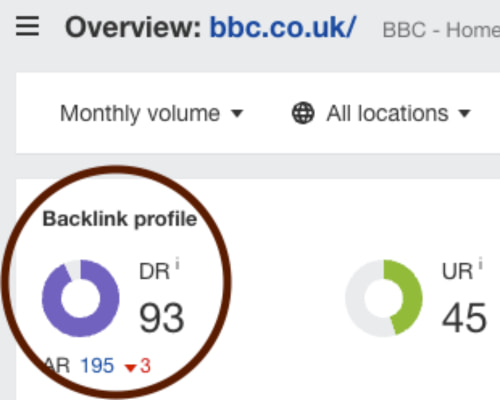
As you can see here, using Ahrefs, you can find out the domain authority of your own site, and in this example, we’re using the BBC. They’re clearly well-known nationwide, are extremely reputable in their niche, and have most of, if not pretty much all of the factors required to gain a high domain rating (same as domain authority).
What is a good domain authority score?
Across the board, a good domain authority score is 50-60 and above, but this depends on your industry. For example, if all your competitors have a score of 20-30, then 40-50 could be classed as good. Therefore, what a good domain authority score counts as all depends on your competition within your field so it may be worth looking into all of that first.
Remember though, if you’re on the lower end right now, it’s a lot easier to increase that number, whereas massive companies at the top end of the domain authority (DA) will find it much harder to increase their numbers so significantly.
So, the morale of the story is that your DA can always be improved first of all, and your competition plays a huge factor in the ceiling you can reach. It’s just another area of your business that can be improved over time. To check how you compare against your competitors, you can very quickly do that by:

^ Firstly, type your URL into the search bar in Ahrefs and press enter.
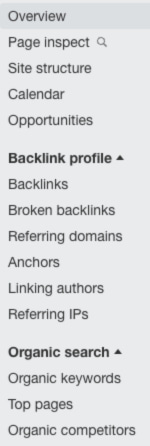
^ Secondly, click on organic competitors down the left-hand side of your screen.
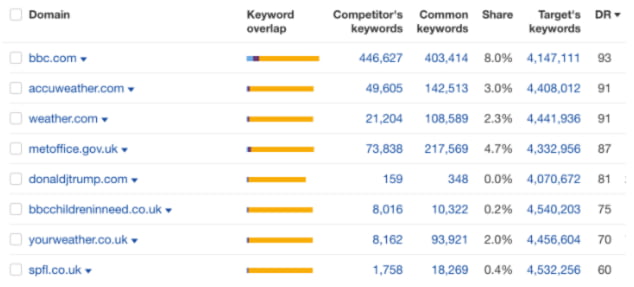
^ Lastly, scroll down to ‘top competing domains’ and simply look at the DR on the far right of the image above and see how you compare to those in your industry.
How is your URL domain authority calculated?
Actually calculating this score is something that only algorithms can understand. However, this doesn’t stop us from learning and understanding on a generalised basis how this score is calculated to give you the score you have on paper. Here’s what we know:
- The power of your backlinks – All websites have a backlink profile (a number of links from their website being placed on other websites) and depending on the quality and quantity of them, will determine how much it improves your score.
- Your spam score – This is another score that determines how spammy your website comes across, i.e. are you manipulating links to trick your rankings on Google and other search engines?
- The number of linking root domains – Having loads of links can be great, but if they all come from the same root domain (same website), you’re not generating unique links, which is a huge part of domain authority success.
- Your organic traffic – This is essentially how many visitors you’re getting to your website by organic search, whether that be people searching for your brand or finding you through non-branded search queries.
Overall, the creator of domain authority had this to say about how it’s calculated, which is a nice summary of the above factors “Domain Authority is calculated by evaluating multiple factors, including linking root domains and the total number of links, into a single DA score. A domain’s DA score is calculated using a machine learning algorithm that predicts how frequently a domain appears in Google’s search results compared to its competitors.”
How to increase your domain authority with 5 simple steps
Being an SEO agency based in Liverpool, we have seen clients improve their domain authority, along with overall business performance taking off. So, here are some of the unique findings from years of experience monitoring clients websites (and our own):
1) Creating content that is linkable is king
Creating great, natural content that is shareable will be one of the most important ways you can improve your domain authority. If your content comes across well, is high-value, and is insightful/original, then you will start seeing some big sights swooping in to link to your content.
Not only that, but if readers find it really helpful (should be the main goal of your content), then they will share it with friends, family, or teammates alike to share the knowledge you’ve provided.
If you’re not sure what type of content to produce, assess your competitors. What content are they creating and what keywords are they using that you can target with your unique input?
2) Attaining high-quality links from reputable sites
Using link-building strategies is one of the backbones of your entire SEO strategy, and you’ve got to think, most website owners don’t even know what backlinks are, and since backlinks are a ranking factor on the biggest search engines in the world, they’ve got to be important, right?
Well, using our top ways to attain backlinks, you can make sure to sidestep your competition to make sure you’re always one step ahead of the curve. Here are some examples of what high-quality backlinks look like:
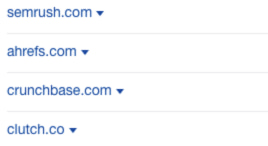
As you can see, these are some of the backlinks we’ve acquired over the years, and their domain rating (DR) is north of 90, meaning they’re extremely reputable websites linking back to our websites, pages, or blogs.
3) Get listed on relevant and useful directories
Directories sometimes get a bad rep due to them seeming spammy, especially if you’re being placed on low-quality websites. However, directories (websites that provide a catalogue of businesses) that are trusted and actually suggest great businesses can be an amazing way to get recognised.
Using sites such as:
- Yelp
- Google My Business (technically)
- Angi
- TripAdvisor
- OpenTable
- Hotfrog
- ProvenExpert
Will help you to submit your business as a real, trustworthy business within the area you’re targeting that can even potentially boost your rankings over time.
4) You’ve got to have a good internal linking strategy
Internal links are often the forgotten and unsung heroes when it comes to increasing your domain authority. Internal links are essentially links from one page of your site to another page on your website. This is an example of an internal link below:

The text highlighted in orange once you hover over it and click it will take you to another page on our site and in this case it takes you to a case study of our ecommerce clients. This is a great example of an internal link because, first of all, you know exactly where you’re being directed, and the anchor text (text highlighted) is not so robotic; it just flows naturally within the content.
With internal links, your homepage is always going to be your most important link, but when carrying out your internal linking strategy, you need to:
-
- Focus on targeting your key money pages
- Don’t link to blogs from money pages
- Make sure they’re natural in your content
- Make sure they’re not misleading
- Don’t over-spam internal links to the same pages… the goldilocks effect
- Don’t avoid orphan pages (make sure every page has an internal link) as they may not be indexed.
5) Get rid of those bad or even worse… broken links
If you carry out your own SEO audit or go to a professional for a free SEO audit, you will most likely quickly notice that you have a lot of bad, if not broken links on your website, which can massively impact your website authority and SEO performance overall.
Bad or broken links make it really hard for Google to crawl your website, and Google will never want to direct people towards websites with links that don’t work, ultimately decreasing your authority.
Once the SEO audit is done, you can then remove the toxic or spammy links from your website’s existence, and even if you can’t do that, you can use Google Search Console (GSC) to ignore or disavow them links, meaning Google won’t even take these into consideration when indexing your website for domain authority.