
No matter your eCommerce business, your goal is to either get more eyes on your website or more sales for your products; there’s no getting around that. However, the hard bit is actually making this happen.
While the statistics prove that SEO for ecommerce websites returns a very profitable ROI, some are still blind to the fact an ecommerce SEO strategy can really impact your performance.
Ecommerce websites on the first page of the Google search engine results pages (SERPs) have an average conversion rate of 10.18%. 93% of people say that product reviews have a major impact on their purchasing decision, and 70% of all traffic on an ecommerce site is the cause of long-tail keywords.
And this is just scratching the surface of the astounding statistics that SEO can provide, so let’s take a look at how you can implement or refine your ecommerce SEO strategy for greater success.
What is ecommerce SEO?
To put it simply, ecommerce SEO is the practice of simply gaining more visibility through search engines, primarily through Google. So let’s say you sell custom-made trainers, the SEO strategy would be built upon gaining more traction to your website through multiple SEO strategies in order for you to gain more revenue and attention when people search for products like yours.
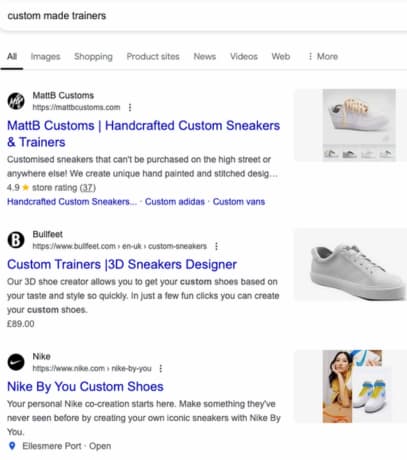
^ Now these are the most trusted brands for custom-made trainers due to them being the most highly-rated on Google.
What type of SEO strategy you need, in our opinion, will always be tailored to you, because there’s no one-size-fits-all approach for any business trying to improve their rankings on Google.
Real-life example of ecommerce SEO working a charm

This case study from one of our ecommerce clients in the wine industry shows how integral a SEO strategy can be. We found several issues on their website, along with producing a 6-month content plan to answer all the questions their audience had about wine, the products they offer, etc., and the results… well, they speak for themselves.
How to create an e-commerce SEO strategy for similar results?
Although not every business is the same and within an SEO strategy, different practices will take place, we believe there’s an approach that you can take that will help you plan out what needs to be actioned. Here’s exactly what you need to know about the basics of an SEO strategy so you can begin implementing some facets into your marketing campaign today:
- Completing an SEO audit
- Look at your competition on Google SERPs
- Conducting industry-related keyword research
- Creating killer content
- Building high-quality and authoritative links
- Constantly assess your results
1 – Completing an SEO audit
Completing an SEO audit on your website, especially if you’ve had it for a long enough time and you’re not getting the results you desire can be an extremely telling sign of what’s going wrong with your site. Whether it be on-page problems, crawling issues, and many more aspects of SEO, oftentimes, you’ll be able to find out what is causing some major issues.
Whether you use tools such as Semrush or Ahrefs to find out yourself or trust an SEO agency to carry out an SEO audit for you, this can be the first step in the right direction of creating positive results for your website.
2 – Look at your competition on Google SERPs
With no competition, oftentimes it won’t be as fun, but this doesn’t stop you from taking a look at what the high-performing ones are doing that you could either implement yourself or spot areas in which you could outperform them.
A complete competitor analysis allows you to really set out your objectives about how you want your brand to stand out. Whether you use SEO tools or simply look at your competitors on Google SERPs, both will be extremely useful for your research and improvements.
3 – Conducting industry-related keyword research
Possibly one of the most important facets of an ecommerce SEO strategy is finding the right keywords to rank for. What you may have thought would perform well on the SERPs, people may not even be searching for.
Whether it be long-tail keywords, informational keywords, short-tail keywords, and more, finding out what your customers are actually looking for when they’re using Google is vital.

^ Here’s an example of an informational enquiry someone may have for a VPN provider that they could potentially answer within their content marketing strategy. This is just one example of hundreds you could use (obviously relative to your business and niche!)
4 – Creating killer content
When creating killer content, there are a few things you have to ask yourself beforehand:
- Would your website benefit from blog content answering queries about your product and industry?
- Do you have keywords for this piece of content to make it rank highly?
- Are you an authoritative figure in your field?
- Is your content well written and unique?
- Would you buy your own product if you were on the other side of the screen?
- Is your content actually relevant to your product and industry?
- Is your content readable and easy to read/digest?
- Do you have any duplicate content anywhere on your website? If so, get rid.
These are just a few of the many questions you need to ask yourself before you write blog content, content for money pages, service pages, location pages and so on.
5 – Build high-quality and authoritative backlinks
One of the biggest factors in becoming a trusted and reliable company who ranks highly on Google for their products is Google E-E-A-T (experience, expertise, authoritativeness, and trustworthiness).
Google can rank this on too many factors to list, but certainly, one that impacts this massively is your link-building strategy.
Building high-quality links can boost the authority of your website, help you gain media opportunities, and ultimately boost your performance in the search results, because essentially, if your company is all over high-authority sites, then you’re more likely to be a high-performing and trustworthy company. Some of the ways you can do this are:
- Creating guest posts
- Looking for media opportunities presented by journalists
- Creating PR publications for press mentions
- Partner with influencers
6 – Constantly assess your results
Now, this one should be a given, but a lot of companies forget about tracking their results because they’re so busy pushing things out to their audience. Especially as an ecommerce company, you need to know what products are selling well, what type of content is performing best, what your audience doesn’t react well to, and more.
Data can be one of the most useful ways of turning unsuccessful SEO campaigns into good ones. It also gives you more chances to be creative in your A/B testing phases. Don’t sleep on analytics!
Must-knows when it comes to ecommerce SEO
Now that you have a great idea of potentially what you’ve neglected in the past and where to start, it would be hard to do that without some of the must-knows. We want to help you prevent as many mistakes as possible, so here are some useful tips to take into your strategy:
Tools to use
To actually implement what we’ve spoken about today, you need the tools to do so, so here are some of the best tools you can use for ecommerce SEO today:
These are some of the most simple to use, basic tools that you can use if you want to start looking at your SEO performance and figuring out why it’s not going the way you want it to.
Don’t neglect technical (off-page) SEO
Although there are parts to technical SEO that are extremely complicated, even for the experts, neglecting it can be the worst thing you can do. Things like site speed, user experience, internal/external links, and many other things can be damaged massively, ultimately preventing you from rising up the results pages.
Just understanding your target audience
Everything from what platform they use, the content they like, their demographics, age, sex, etc., can be so important in the continued performance of your ecommerce SEO campaign. Think about it, if you’re marketing to people who don’t care about your business, all your core metrics will be nowhere near where you want them to be.
Take time to research, gain feedback, and ask questions, because once you create an unbreakable relationship with your customers, you will often receive repeat business for a long, long time.
An easier way to more successful ecommerce SEO results
We would hope that you come away from this blog a lot more knowledgeable, but oftentimes, it just shows how much work needs to be done on the SEO side if you want to compete against the highest level of competition in your niche.
Whereas, partnering with an SEO agency like Quirky Digital will not only allow you to take some of that stress off your hands, but we’ll also work together to make sure we get tailored results designed for what you want.
Ultimately, you’re the owner of your business and what you want to rank for or what you want to sell is your decision. We’d just be there to make that happen with our proven strategies. If you’re interested in teaming up, we’d love to hear from you about how we could work together on your project—give us a call today!