If you’ve been part of the SEO community for the past year or so (or watching from afar), you’ll know that there’s been a huge shift in how content is written, the efficiency of businesses, and the entire SEO process as a whole.
Now, unless you’ve been living under a rock, you’ll know the rise in AI (artificial intelligence) within the Google search engine results pages and how big of an impact it’s had on search engine optimisation.
As you can see from the image below, according to an ongoing study, 19.10% of all content online can be AI-detected, compared to just 2.77% in February 2019.
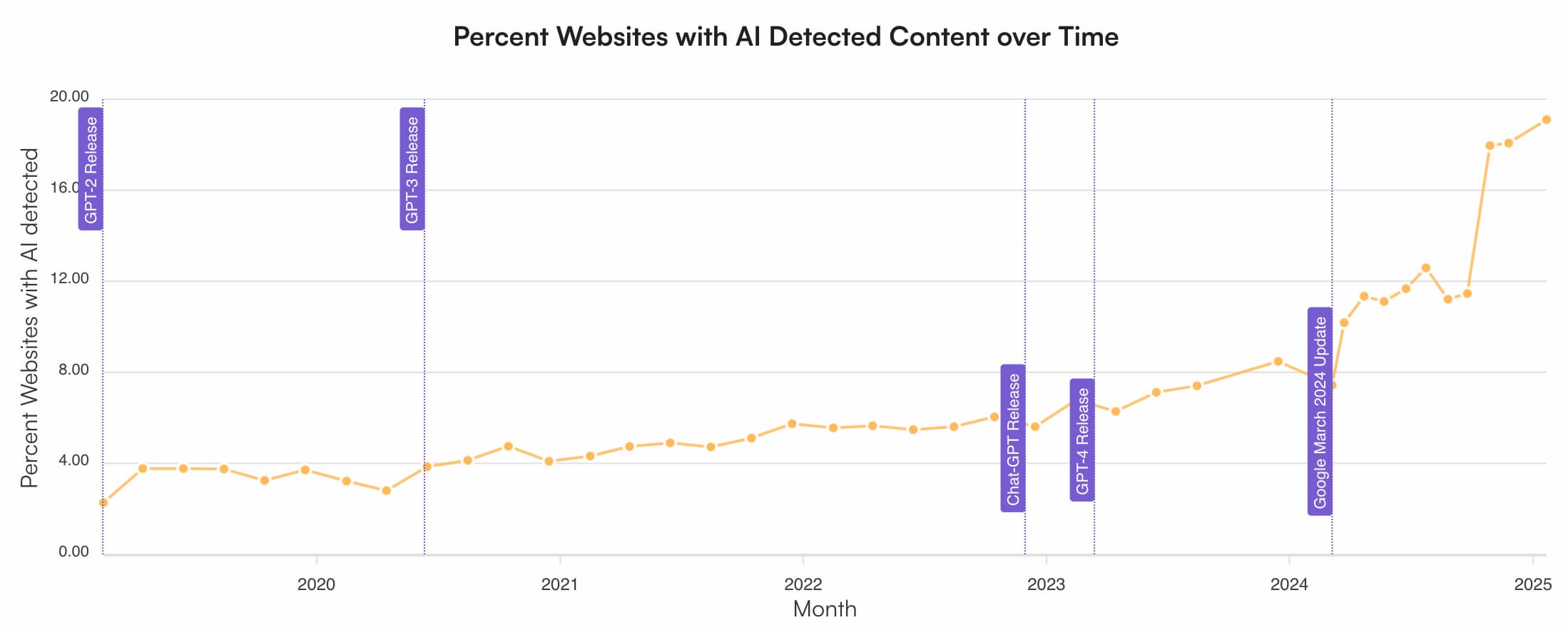
Yet, as AI continues to grow, we’re going to have to get used to it and optimise for it, so that’s why today, we’re going to look closely at GEO (generative engine optimisation) and how you can master it for your business.
What is generative engine optimisation (GEO)?
As a quick summary, generative engine optimisation means you’re optimising your content to be recognised by the AI-driven search engines. You’re basically trying to not only increase your visibility in the normal search engine, but also trying to be visible in search engines such as AI overview, Perplexity, Google Gemini, ChatGPT, etc.
GEO had no specific date as to when it was introduced, but I think everyone would’ve heard of the introduction of ChatGPT back in November, 2022, and I think this is where everyone realised the power of AI and how it can change and impact our future.
As you may have noticed when you search for something in Google, it’ll take you to an AI overview, where they take responses from legitimate sites and summarise it while linking to the original site. Or, when searching on Perplexity or ChatGPT, it’ll give you sources of where it found the information—this is where you want to be appearing for the most brand visibility.
How does generative engine optimisation work?
Now, this is going to get very technical, but a generative engine works and is often powered by a large language model (LLM), meaning it retrieves, analyses, and generates original content based on the prompt you enter into the search engine. Essentially, it pulls information from relevant and accurate sources and generates its own answers based on the data it’s been trained to extract.
Let me just show you a visual example to get a better gist of what I meant in that technical jargon:
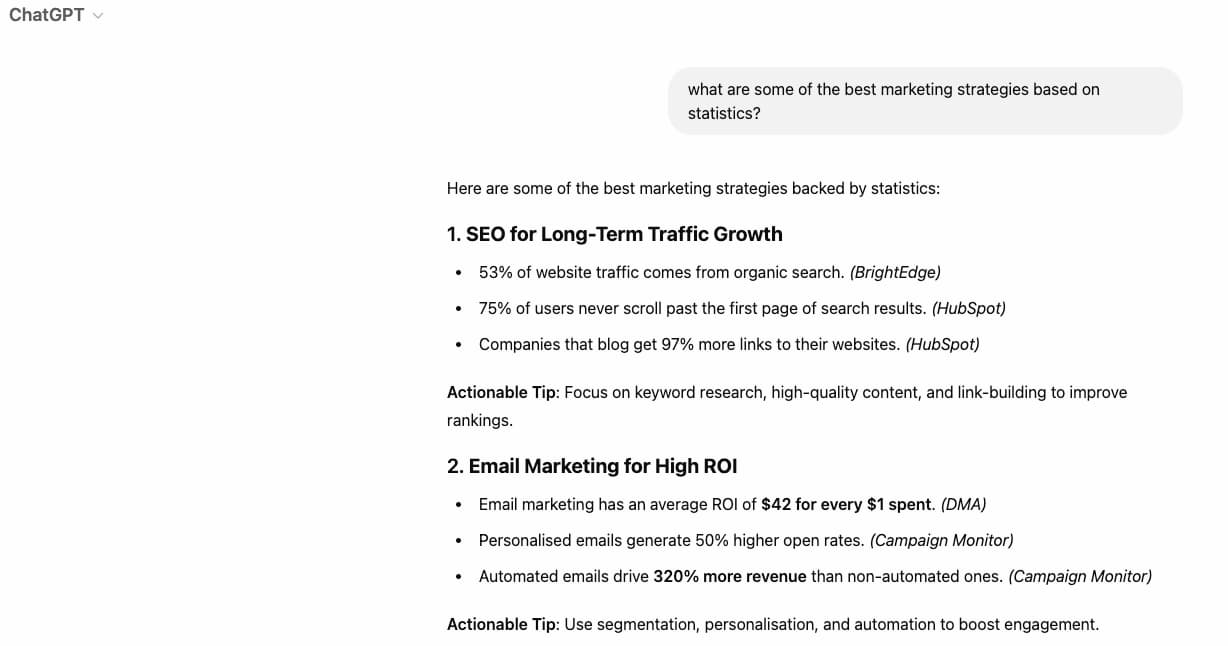
Here, I asked ChatGPT to give me some of the best marketing strategies to use based on statistics. As you can see, it’s pulled information from reputable sources such as HubSpot, Campaign Monitor, BrightEdge, etc., by generating its own opinion using the statistics from across the web.
However, you can go much deeper into the rabbit hole by making it more relevant to you by providing information on your own business, so it can understand your unique query. For example, let’s keep going:
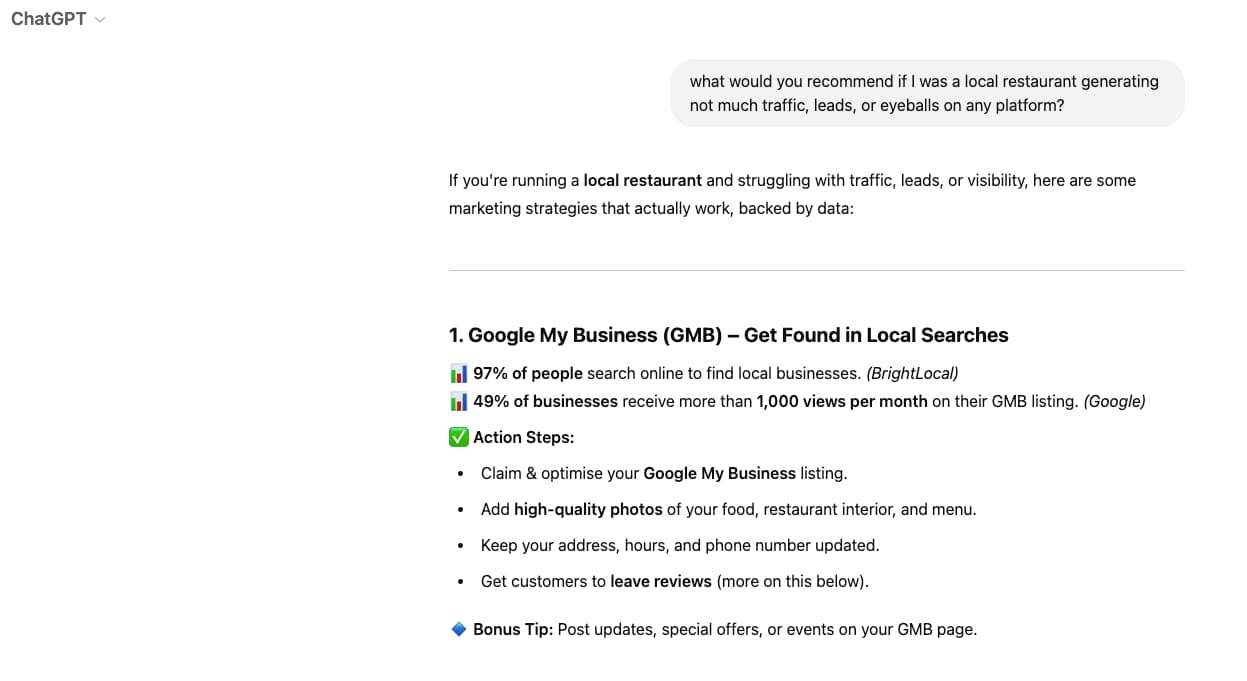
As you can see, I made the query more relevant to a local restaurant wanting to increase their visibility online for ‘near me’ searches, and it gave me specific tailored information for my query. This is just ChatGPT too—there’s plenty more platforms/search engines where you’ll receive original answers related to your search queries.
GEO vs SEO – Similarities and differences
When it comes to looking at the similarities and differences between GEO vs SEO, there are many surprising ways they’re both very much alike, but also completely different. Let’s break them down here:
| Similarities (GEO vs SEO) | Differences (GEO vs SEO) |
|---|---|
| Both aim to help the audience find the true answer to their query | SEO provides you with information from organic, real businesses – GEO crawls real business information and generates its own response through its trained data |
| Both create content that is easy to understand and navigate | SEO aims to just rank one page higher, whereas GEO focuses on gathering multiple sources and generating an ‘overall’ answer |
| Both understand the importance of the E-E-A-T (experience, expertise, authoritativeness, and trustworthiness) principles | SEO will adapt based on what’s changing in the search engine algorithm, whereas GEO will adapt based on how quickly AI technology can advance |
| Both stay up to date with the latest data and market trends to release the most relevant information | SEO focuses on optimising content for normal search engines, whereas GEO gathers information from content formatted in easy-to-understand natural language processing |
| Both know the importance of keywords, making sure it reaches the right people with user intent | SEO focuses on tracking performance from rankings, keyword performance, etc., whereas GEO tracks referral traffic from cited sources and AI engines |
| Both understand the importance of the technical aspect too (mobile friendliness, load speed, crawling, etc) for user experience | SEO gives you information based on the keywords, whereas AI looks to create more of a nuanced response based on individual situations |
How to master generative engine optimisation (step-by-step)
If you want to master generative engine optimisation and become one of the first businesses within your niche to recognise this as a serious opportunity, we’ve spent far too long researching this subject… but have found a few paramount factors that should be included in your strategy moving forward to find yourself sliding into the AI query answers:
#1 You must optimise for traditional search engines first and foremost
Yes, I said it, and I know this is counterintuitive with the whole GEO vs SEO narrative in this post so far, but to even be considered by the AI search engines, you must have a solid SEO strategy, whether it be a local SEO or international SEO strategy in place for search engines like Google so you’re on the radar of the LLM when it’s pulling it’s data and information from real businesses. So, yes, you guessed it… SEO isn’t dead.
#2 Do extensive research on competitors who are performing well
Like SEO competitor analysis, you have to do the exact same thing with GEO. Go and look at some common queries within your industry, common keywords within your industry, etc., and make notes on what you can spot is working for them within generative AI results.
As we say all the time, it will not be a one-size-fits-all approach. Statistics may work better in your niche than another. Simple, easy-to-understand answers to queries may work better in your industry. It’s all about assessment and refining your own content.
#3 Look to slide into the AI overview answers
According to new studies recently published, AI-overviews showed its face in 74% of problem-solving queries, while showing up in 29% of the 10,000 keywords that were studied. If this doesn’t show you there’s an opportunity to find yourself in an AI overview, I don’t know what will.
Yet, how do you do this and what are the best practices for getting into AI overviews:
- Be clear, concise, and easy to understand within your content quality
- Answering FAQs within your niche (e.g., ‘What is the best supplement to take for sleep?’) if you were in the dietary supplement field
- Using relevant and trustworthy statistics within your content
- Using LSI keywords within your content to improve accuracy for relevant and common queries within your industry
- Becoming an authority within your niche to abide by the E-E-A-T principles by improving link-building strategies and digital PR
- Having testimonials, case studies, and reviews on your website so you’re a trusted entity
- Answer step-by-step instruction-based queries in layman’s terms
- Make sure your content is aligned with Google’s helpful content update
#4 Featuring on ChatGPT, Perplexity, etc
So, what does the likes of ChatGPT and Perplexity look for when assessing what trusted entities will show up when a user query is asked? In fact, I’ll let them tell you themselves:
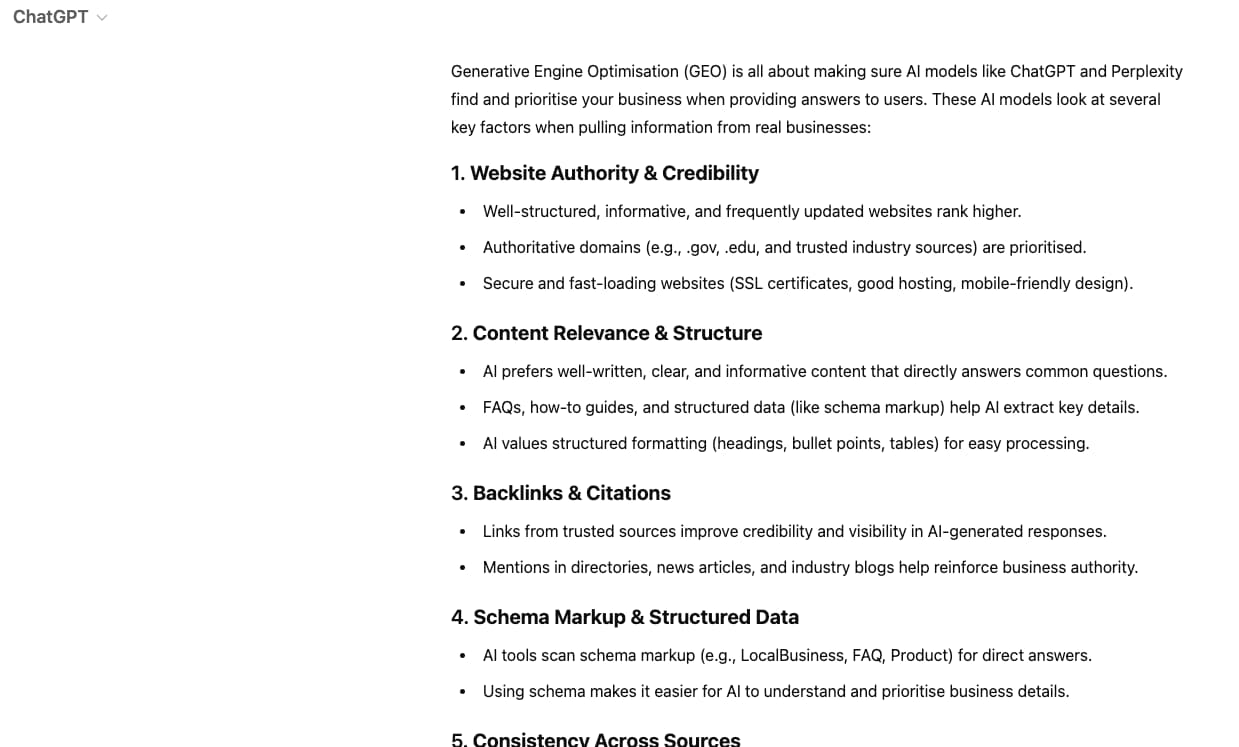
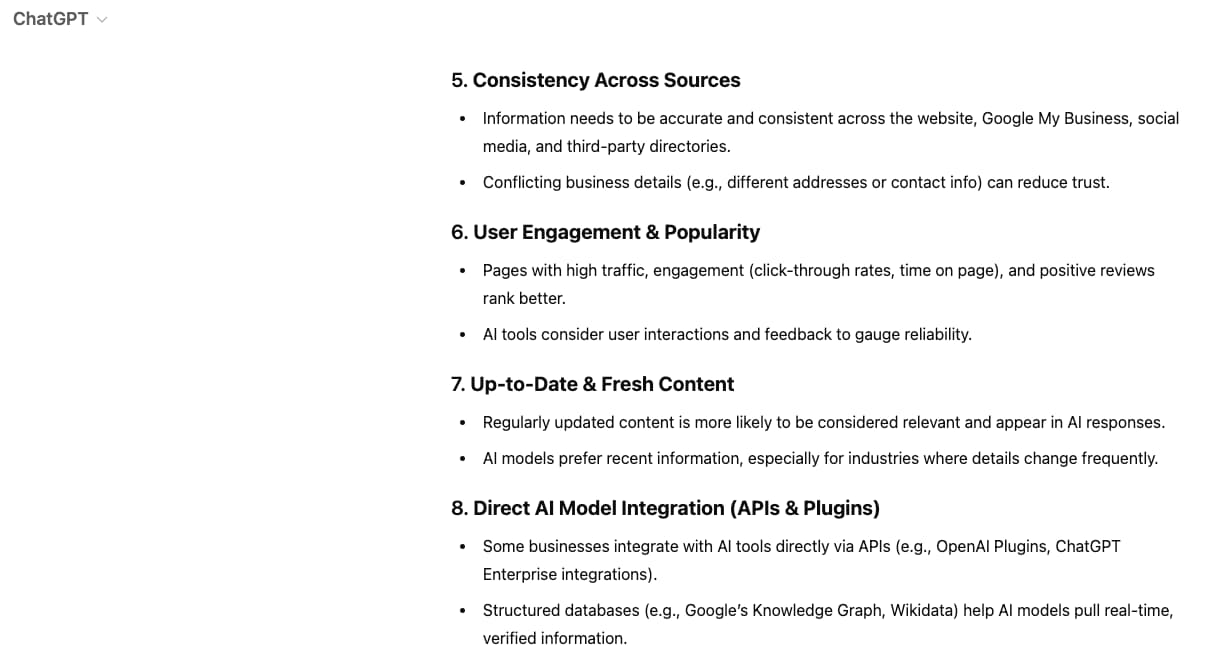
Key takeaways, focus on building:
- Credibility and authority
- Having relevant content and good structure
- Adding high-quality backlinks and citations
- Implementing schema markup & structured data
- Having some consistency across your sources
- Having content that is popular, shareable, and engaging
- Making sure your content is fresh and up-to-date
- Having direct AI model integration (APIs and plugins)
What is Quirky Digital’s opinion on whether generative engine optimisation works or not?
In this phase of the blog, I thought we’d turn internally to someone who’s been studying this relentlessly and seeing the results over the past couple of years.
Here’s what Rachel Ball, our Head of SEO, had to say about generative engine optimisation and the effectiveness of it:
“At the moment, it’s still very difficult for us to influence generative AI search results because it is often pulling in information from web pages that don’t rank in top ‘blue link’ positions. In some instances, we actually see that generative AI results are pulling from relatively low-ranking results as far as the third or fourth page of Google’s results. For this reason, we know that the optimisation techniques we typically use are not necessarily going to carry the same weight for these results.
There have been many complaints about the accuracy of the generative AI results we’ve seen so far and we expect that these will get better with time, but for the moment, my recommendation to our clients is to simply keep creating high-quality content that meets the optimisation standards we strive for when trying to rank well for classic blue links. The better that Google’s generative AI model is trained over time, the better it will become at detecting quality results and so keeping this as the focus will never lead us astray.”
Overall, the only way you’re going to adapt to the new age of SEO and GEO is by trying to implement it within your strategies and A/B test all the time. If you’re too far against it, you’ll get left behind. For example, here’s an AI overview we’ve recently held and secured for ourselves within the SEO industry, followed by Google for Developers and Rock Content.
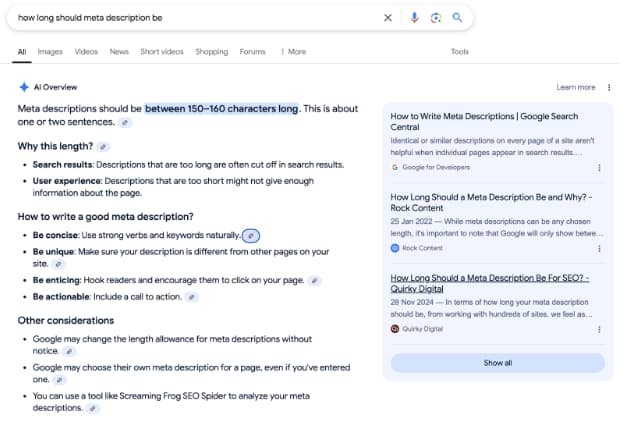
Yet, this doesn’t mean we’ll hold this position and authority for this search term forever. We’ll have to keep adapting our content, adding to it, optimising it, etc., to keep it fresh and up-to-date with any changes within the industry.
What is the future for generative AI?
Now, we can’t sit here and say exactly what we know is going to happen because I’m sure new innovations will take us by surprise, but there’s been some speculation from a research paper that you can increase your brand visibility by 40% by implementing GEO techniques within your marketing strategy.
Not only that, but Gartner has predicted that there will be a big drop in traditional search volume by 25% by 2026 and organic search traffic is expected to go down by over 50% as consumers embrace AI-powered search (all speculation, of course).
Now, currently SEO and GEO are working together in a weird way to generate the most useful search results for the user, and this may continue for some years, but you have to expect that there will be changes, innovations, new techniques, etc., that will come in the following years. If you’re not willing to adapt, you’ll fail.
How can Quirky Digital help you navigate these changes?
As a traditional SEO agency by trade, we understand that GEO is having an effect on our industry, but rather than shying away from it, we’re getting curious. We’re testing. We’re constantly evolving and growing our knowledge on the subject so our clients can benefit from this new form of search.
This, partnered with our already extensive knowledge on the subject of SEO and how search engines work, will make us one of the trailblazers of tomorrow’s tech-driven agencies, along with today’s.
Therefore, if you want to partner with an agency that is open to change and simply wants the best for every business that has ever worked with us, reach out to our team today. We look forward to hearing from you!