
PPC, known as pay-per-click, has been around since the mid-1990s but has never stopped growing and evolving as the years go by, no matter how well it may be performing for certain businesses.
And although you may think because it’s been around for a long time that it doesn’t perform anymore, you’d be wrong, as according to Wordstream, for every $1 you spend, you make $2 back, meaning there is a 200% ROI on average!
Therefore, if you’re looking to add it to your marketing strategy, here are some key PPC tips and tricks you need to know before you run into it blindly.
What is PPC (pay-per-click)?
Pay-per-click (PPC) is essentially where you use Google’s ad platform to get your page to the top of search results marked as ‘sponsored’. However, the key thing to remember is that you only pay for this type of advertising if someone actually clicks on your sponsored piece. Here’s a quick example of what it looks like on Google:
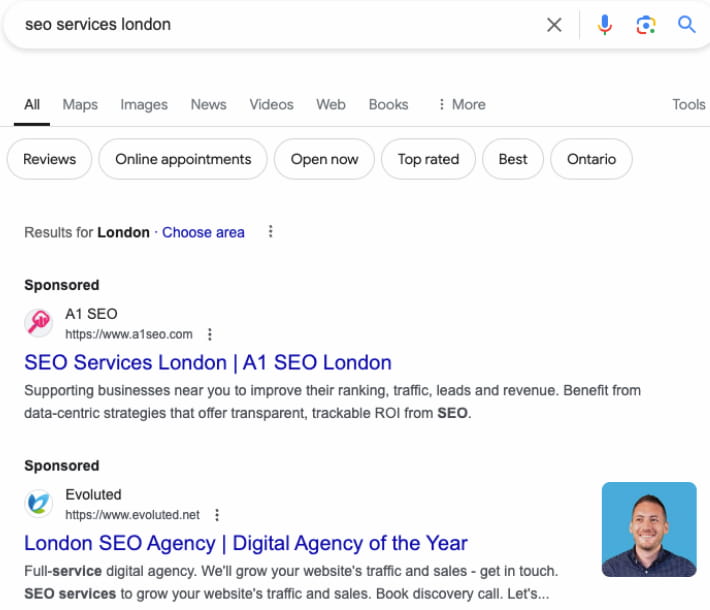
As you can see, it appears at the top of page one if you’re willing to pay a bit more. Typically though, it is less expensive to advertise on any other page of the SERPs (but almost pointless, as most only look at the first page).
This ensures that at minimum, you’re at least getting someone to visit your page (and website). Whether they act on what your CTA (call to action) is or not is simply down to them and how much your page persuades them to take action.
7 PPC tips that will boost your ad performance
- Know your goals for the PPC campaign
- People need to care about the keywords you’re trying to rank for
- Having relevant and compelling copy
- Targeting the correct audience that will maximise ROI
- Choose the most suitable bidding strategy for your goals
- Always be A/B testing
- Measure and stay on top of your ROI
1. Know your goals for the PPC ad campaign
A study by Dominican University when researching goal setting found that people who actually set goals are 43% more likely to achieve them compared to those who don’t. This is not just because it is there for you to see more often, but setting goals allows you to create a structure and clear plan of what you want to do and how you’re going to do it.
The same goes with PPC. If you just have a blurry vision of what you want to do, then it will be a blind campaign with no real meaning. Here are some questions you can ask yourself to create structured goals:
- What do I want to achieve from this campaign?
- What is my target audience?
- Do I want conversions or engagement?
- Do you have targeted keywords?
- What are my other creatives going to be if this one doesn’t work?
- How much am I going to spend?
- What do I want my ROI to be?
2. People need to care about the keywords you’re trying to rank for
Keywords are one of, if not the most important factor when it comes to building a PPC marketing campaign that gets results.
For example, let’s say you’re a business selling handmade bracelets, but you try to get clicks for ‘blue and white handmade bracelets in Liverpool’, no one will be searching for anything like that. Whereas, if you simply try to get clicks for ‘homemade bracelets’, you’re simply going to get more clicks and conversions.
This is just a very simple example because a lot of long-tail keywords do get great results, but you get the jist. People have got to care. Some of the keyword types you can take a look at on big keyword research tools such as Semrush and Ahrefs for the best results are:
- Long-tail keywords – Longer keywords with less competition, meaning a lower price
- Low-volume keywords – These are keywords that fewer people search for, but can be very niche to what you’re selling
- Negative keywords – Allow you to remove any irrelevant search terms related to your campaign.
3. Having relevant and compelling PPC ad copy
When creating a PPC campaign, you must have clear and compelling content marketing; otherwise, people are just going to bounce from your site as soon as they read the first sentence. Some tips that will improve your copy include:
- Using testimonials and reviews (72% of consumers say it increases trust in a business)
- Showcasing the brands you’ve worked with (if you’ve worked with notable brands)
- Making it easy to digest and simple to understand exactly what you do with features and benefits
- You have to be persuasive in your copy if you want people to buy
- You need clear and actionable CTAs (calls to action) throughout the page
- Adding live chat for quick support
- Having a clear structure to the page (headings, subheadings, bullet points, etc)
- Discounts and FOMO
4. Targeting the correct audience that will maximise ROI
Finding your target audience is something you should’ve already done as a business owner, so this shouldn’t take much to implement. However, if you’re a startup and want to run search ads straight away, this is a huge part of it.
If you’re sending your PPC out to people who don’t care about your products/services, then you’re never going to see any conversions. The best question you can ask yourself to find out your target audience is “Who is my ideal customer if everything about them ticked the boxes?”
Quick tip: Make sure you determine the location, interests, demographics, behaviour, type of device, analyse competition, look at your current social media following, etc.
5. Choose the most suitable bidding strategy for your goals
Now, getting slightly more advanced and technical, the right bidding strategy is a massive component of how visible you’ll become and how much it’ll actually cost. Here are the main types of bidding strategies that Google themselves talk about:
- CPC (cost-per-click) – If you just want traffic to your website, this will be ideal
- vCPM (cost per thousand viewable impressions) – If you just want to boost your brand awareness
- CPV (cost per view) or CPM (cost per thousand impressions) to increase interaction with ads
- Target return on ad spend (ROAS) – Solely based on optimising your conversion value
- Target cost per action (CPA) – To simply increase conversions
- Enhanced cost per click (ECPC) – automatically adjusting your manual bids to try and maximise your conversion rate
6. Always be A/B testing
Unfortunately, your first ad ever on Google may not always be the best-performing. Not to worry, because this is your first ad! However, you do need to have backup plans and optimisation strategies ready to try with each ad you put on Google.
You can’t expect the first one to perform and then that’s it, you’re successful. It doesn’t work like that, unfortunately. Therefore, here is a great video we recommend watching for the elements you can optimise and change during A/B testing:
7. Measure your PPC performance and stay on top of your ROI
Oftentimes, businesses can get lazy with tracking their campaign performance and results when testing, especially if you’re a huge corporation with a large ad budget. However, if you’re not tracking your performance and calculating your ROI, you won’t know how much money you’ve made from advertising.
Tracking your ROI can make sure you know whether Google Ads is the right option for you or whether you simply just need to test another ad creative.
Quick tip: To track performance and ROI, use conversion tracking and Google Analytics to help you find out your core metrics.
In Roundup
Now that you know the power of PPC and how it can improve the traffic, conversions, and engagement of your site, you may want to start implementing this as soon as possible.
However, while PPC can be an effective marketing tool to gain results quickly, it is not always the most sustainable method for bringing in lifetime customers/clients, real relationships, and organic growth.
PPC can sometimes be damaging to your reputation when starting out and consumers may find it a bit spammy. Therefore, if you want to partner a little bit of ads with something more organic and sustainable long-term, we highly recommend you look into SEO and the benefits it can provide for your business.