
As the first line of business, we’re told to build our brand and have our mission, values, and vision distributed out to the world, but in SEO, we’re typically told that you should optimise your website to be less branded, as this is what will attract a completely new target audience to your products or services.
It’s quite confusing, truth be told, as you’re in between trying to push your brand, but actually giving people the search queries they’re searching for.
That’s why, in today’s blog, we’re going to talk about branded vs non-branded traffic, the main differences, what the advantages and disadvantages are, and if you should use both for your SEO strategy.
What is branded search?
In short, a branded search is essentially any type of search query (keyword) that contains your company’s name within it. Therefore, anything related to your business, brand, or company’s name specifically would be considered as someone searching for just you.
Here’s a quick example of what that could look like on Google so you can get a visual idea of what we mean:
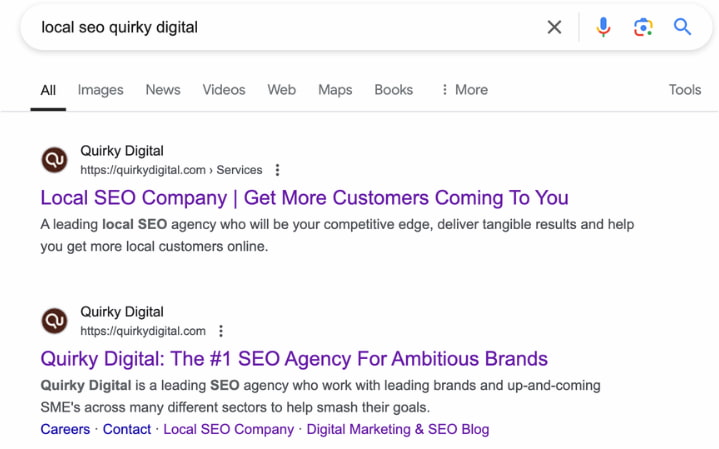
As you can see, although in this example, if someone were to type this into Google—of course, they’re looking for local SEO for their business, they’d also be looking for our company too, as they have our name embedded in their search—meaning this would classify as a branded search.
What is non-branded search?
A non-branded search, or non-branded keywords in simple terms, would be when people are searching for products or services that are in the same industry as you but don’t include your brand’s name in the search. These are typically the people who don’t know who you are yet but are looking for companies to work within your line of work.
Here’s an example of what a non-branded search would look like on the search engine results pages (SERPs):
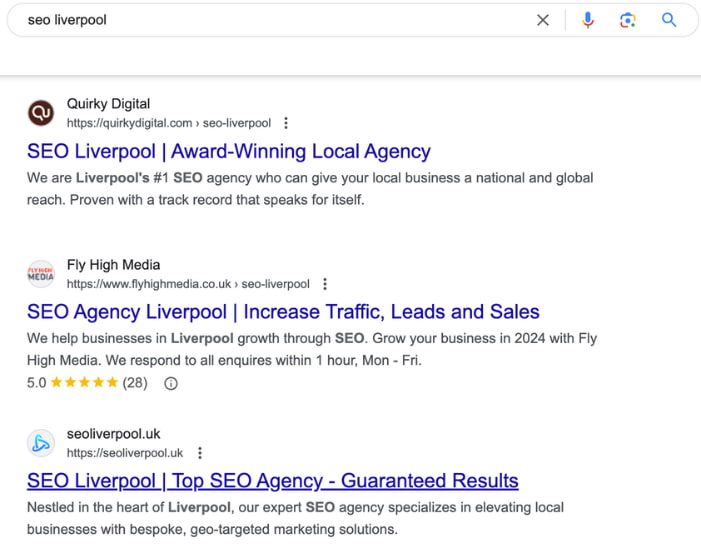
This is an example of a non-branded search, as someone would be searching for just SEO services in Liverpool without knowing what companies they were going to encounter, and fortunately, Quirky Digital would come up as the number one search, meaning that our services would almost certainly be clicked on first by users.
The key differences between branded vs non-branded search?
Although the main difference between branded vs non-branded keywords is that a branded search has your company’s name in and a non-branded search doesn’t, it’s a bit more nuanced than that:
| Branded | Non-branded |
|---|---|
| Branded searches usually mean the leads are warmer and more likely to make a purchase. | Non-branded search intent is usually just to find the best products/services within the search they’re looking for. |
| Likely already visited your website. | Most likely hasn’t visited your website, so you need to impress. |
| Likely already heard of your brand via social media, word of mouth, etc. | Probably hasn’t heard of your brand and will want to do more research before trusting you. |
| You will only show up when they search for your brand if you don’t have good non-branded SEO. | If you have good SEO, you will most likely appear on more of their searches. |
| Unless you’re an extremely well-known brand, non-branded keywords will typically give you more traffic. | Will probably see you around on search engines more unless you have a really well-known brand. |
Should you use both in your SEO strategy?
Whether or not you should use both branded and non-branded keywords in your strategy is not straightforward for everyone. Non-branded keywords are one of the best ways to grow organically, but branded keywords help reinforce the authority of your name as a business.
Therefore, both should be used in your e-commerce SEO strategy (or service-based strategy) , potentially not in the same campaigns, but over time, you’re going to want your non-branded keywords to make your brand recognised across online platforms.
Companies that are just starting out may benefit more from trying to rank for non-branded keywords, as you have a better chance of being found in the search engines that way with there being more search terms to rank on Google for. Whereas, huge companies with an already established brand may benefit from mostly branded keywords mixed with non-branded keywords.
However, it may also be important to lean into branded keywords a bit more initially should your website be brand new (with low authority) and a good metric to balance is leaning on blog posts as a source to gain organic traffic.
Ultimately, either way, it would have to be assessed on a case-by-case basis because every brand is different and that’s why SEO can never be a ‘one-size-fits-all’ strategy.
The Quirky roundup
Gaining value from both branded and non-branded keywords and search terms should be on everyone’s radar. However, it’s certainly not easy to curate an SEO marketing strategy for your business to find out what balance of both works for you.
That’s why at Quirky Digital, we will give you a free, no-obligation SEO audit to help you identify your potential in the SERPs and if you decide you want to take further action, we will:
- Understand your company’s mission and vision
- Assess your competition
- Finding your balance of branded/non-branded keywords tailored to you
- Writing SEO-optimised content that gets search volume, is relevant, and original
- Link-building to make you a trusted, industry leader
So, if you want to get started and come to one of the only SEO agencies in the UK that takes the little details extremely seriously and genuinely cares for your results, speak to us today!